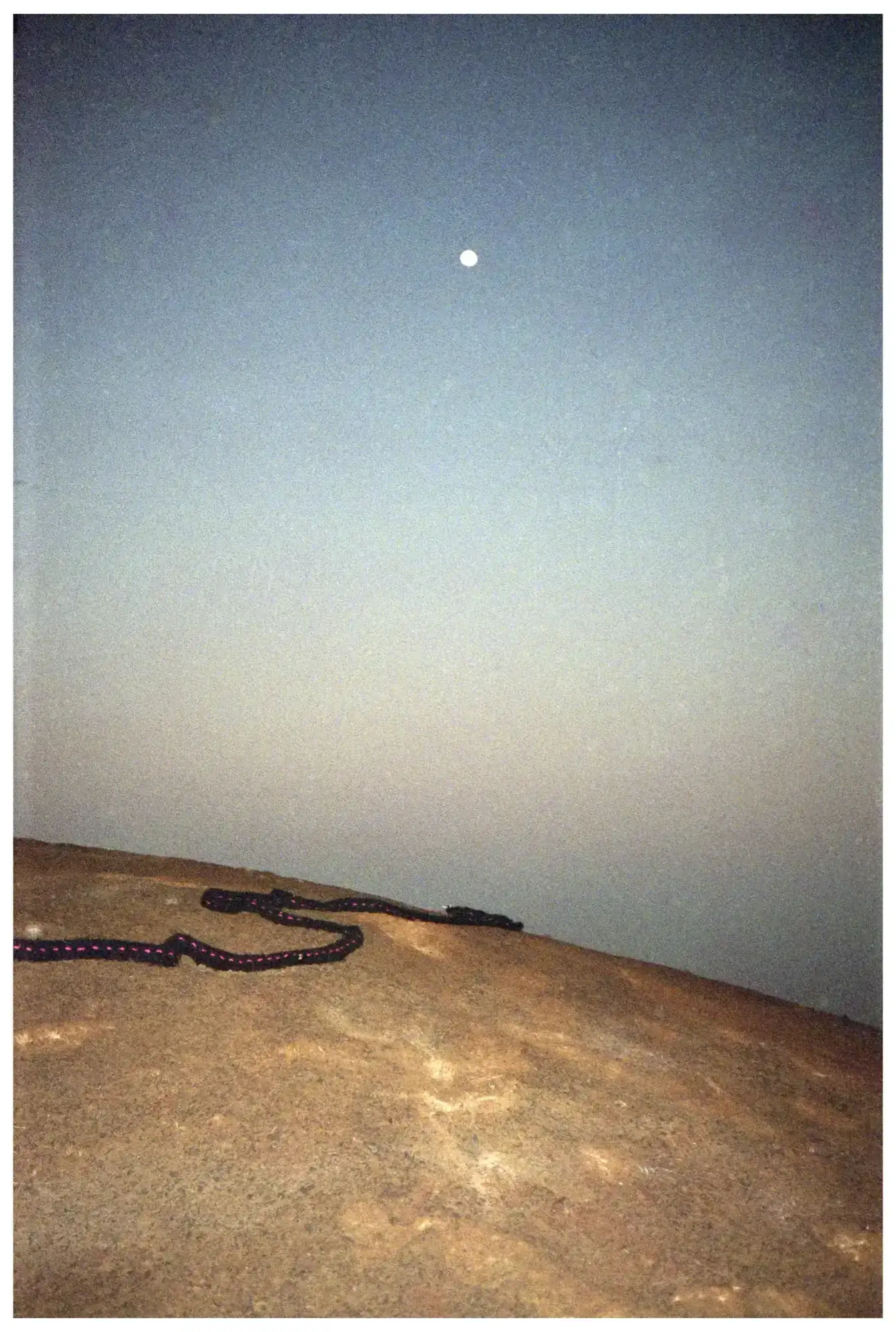
In the trajectory of Curiwarmi, a hybrid creature who has travelled from the Amazon to Europe, multiple worlds become possible. Moving through landscapes marked by displacement, ecological transformation, and the remnants of collapsing systems, Curiwarmi inhabits a speculative territory situated between memory and future-making.
This triptych follows her journey through what could be understood as an approximate "end of the world"—not a final ending, but a moment of rupture in which new forms of existence emerge from the fragments of what has been lost. Within these liminal spaces, Curiwarmi's body becomes both archive and instrument. Through the textiles she creates, she weaves together ancestral knowledge, ecological memory, and forms of communication that exceed human language.
The woven object functions not simply as a material artifact but as a carrier of stories, songs, and relationships. It becomes a vessel through which Curiwarmi gathers experiences across territories and species, proposing alternative ways of inhabiting the world. Her singing, her movements, and her textile-making generate the possibility of another future—one grounded in reciprocity rather than extraction.
The work draws inspiration from Ursula K. Le Guin's The Carrier Bag Theory of Fiction, in which the carrier bag is proposed as one of humanity's first technologies: a container used not for conquest, but for gathering, holding, and sustaining life. In this sense, Curiwarmi's textile becomes a carrier bag of memory and transformation. It collects traces of different worlds, allowing stories, knowledge, and care to travel across time and geography.
Rather than narrating a heroic journey, the work imagines survival through connection. Curiwarmi carries with her fragments of the Amazon, weaving them into new landscapes and new narratives, where the possibility of collective futures can still be imagined.
Curiwarmi is a hybrid creature who journeys from the Amazon to Europe, carrying memories, stories, and ancestral knowledge across landscapes. Set within a speculative world shaped by ecological transformation and uncertainty, the work imagines new possibilities emerging from the ruins of existing systems.
Throughout the triptych, Curiwarmi's body and the textile she creates become vessels for communication, weaving together different territories, species, and temporalities. The textile functions as a carrier of songs, memories, and relationships, proposing alternative ways of inhabiting the world.
Inspired by Ursula K. Le Guin's The Carrier Bag Theory of Fiction, the work understands storytelling as an act of gathering rather than conquest. Curiwarmi's woven forms collect traces of multiple worlds, carrying them toward futures grounded in care, connection, and collective survival.